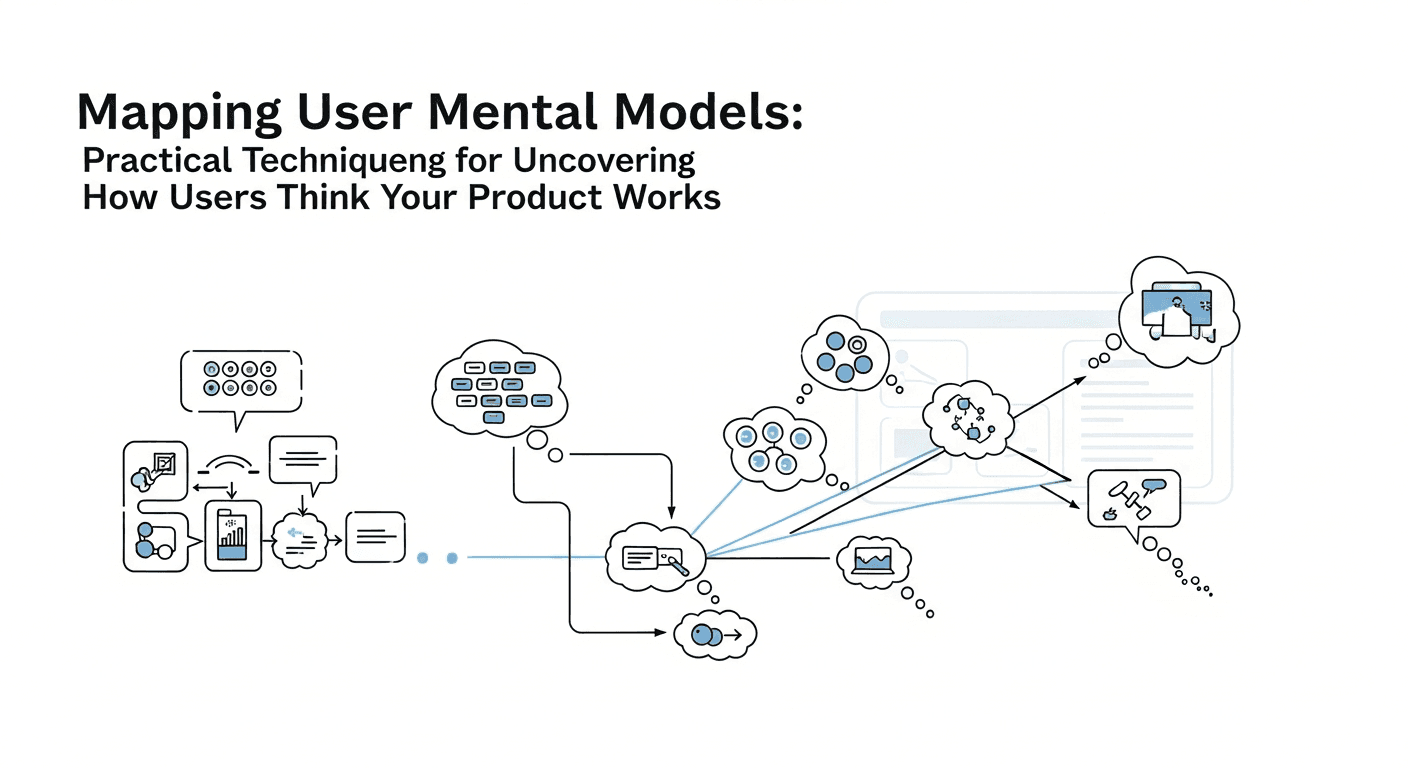
Every time a user interacts with a product, they bring a pre-existing understanding of how things should work. This internal framework, built from past experiences, learned behaviors, and common sense, is what we call a mental model. It's the intuitive theory users hold about your product's functionality, its structure, and how to achieve their goals within it. The challenge for designers and product teams is that these mental models often don't align with the actual design or underlying system model of the product. This disconnect is a primary source of user frustration, errors, and abandonment.
Bridging the gap between the user's mental model and your product's system model is fundamental to creating intuitive, efficient, and delightful experiences. When a product mirrors how users naturally think about a task or information, it feels effortless and 'right.' But how do you uncover these often unspoken, implicit mental models? This article will walk you through practical, actionable techniques to reveal how your users truly think your product operates, empowering you to design solutions that resonate with their inherent understanding.
What Are Mental Models and Why They Matter So Much
At its core, a mental model is a simplified representation of the real world that a person holds in their mind. It's not a perfect replica, but rather a functional understanding that helps them predict outcomes and make decisions. For example, when you see a door handle, your mental model of 'door' suggests that turning it will open the door. If it requires pushing or pulling without a clear indicator, your mental model is challenged, causing confusion or effort.
In product design, users form mental models about everything from navigation structures and feature groupings to interaction patterns and expected system responses. These models dictate where they look for information, how they attempt to complete a task, and what they expect to happen next. Ignoring user mental models means forcing users to learn an entirely new way of thinking, which significantly increases cognitive load and reduces usability. Aligning with them, however, enables users to leverage their existing knowledge, making your product feel instantly familiar and easy to use.
The Cost of Misalignment: When User & System Models Collide
The 'system model' is the actual underlying structure and functionality of your product as designed and implemented. When the user's mental model and the product's system model don't align, friction inevitably arises. Users might struggle to find features, misinterpret error messages, or perform tasks inefficiently because their expectations clash with the product's reality.
Think of a file management system where users expect to 'save' a document, but the system automatically 'autosaves' and provides no explicit save button. Users might repeatedly search for a save option, question if their work is truly secure, or even exit without saving, believing their changes are lost. This seemingly small discrepancy can lead to significant user distress and distrust. Understanding and mitigating these misalignments is a core objective of mental model mapping.
Preparation: Setting the Stage for Discovery
Before diving into specific techniques, a little preparation goes a long way. Clearly define the scope of what you want to understand. Are you mapping the mental model for an entire product, a specific feature set, or a critical user flow? Knowing your focus will guide your choice of techniques and participants.
Identify your target users. Who are the people whose mental models you need to understand? Recruit participants who represent your primary user segments. While qualitative research doesn't require large numbers, aim for 5-8 participants per distinct user group to identify patterns. Remember, the goal is depth of insight, not statistical significance.
Technique 1: Card Sorting for Information Architecture
Card sorting is a powerful, low-fidelity technique for understanding how users categorize and group information. It directly reveals their mental models for information organization and navigation. There are two main types:
- Open Card Sort: Participants group cards (representing content or features) in ways that make sense to them and then label each group. This is best for discovering new categories and understanding user terminology.
- Closed Card Sort: Participants sort cards into pre-defined categories. This is useful for evaluating an existing information architecture or testing specific category labels.
- Hybrid Card Sort: A blend of both, allowing users to sort into existing categories but also create new ones if needed.
To conduct a card sort, write each piece of content or feature on a separate card (physical or digital). Ask participants to group the cards in a way that feels logical to them. Encourage them to 'think aloud' as they sort, explaining their rationale. Analyzing the results, often with dendrograms or similarity matrices from online tools, will highlight common groupings and naming conventions, directly reflecting user mental models of your content space.
Technique 2: User Interviews & Contextual Inquiry
Direct conversation is invaluable for uncovering explicit and implicit mental models. Traditional user interviews, conducted in a neutral setting, allow you to ask open-ended questions about how users approach tasks, what they expect, and what their past experiences have been. Focus on 'why' questions to dig deeper into their reasoning.
Contextual inquiry takes this a step further by observing users in their natural environment as they perform tasks relevant to your product. By watching them in action, you can see their mental models play out firsthand. Pay close attention to: their workflow, the tools they use, their language, any workarounds they employ, and moments of hesitation or confusion. Afterward, follow up with questions about their actions and expectations.
- Ask 'How would you normally do X?' before showing them the product.
- Probe on 'Why did you do that?' or 'What did you expect to happen next?'
- Look for analogies they use to describe your product or task.
- Observe discrepancies between what they say and what they do.
- Pay attention to domain-specific jargon they use; this reflects their professional mental model.
Technique 3: Task Analysis & Workflow Diagrams
Task analysis involves breaking down a user's goal into discrete steps, providing a detailed understanding of their process. While conducting task analysis, you're not just documenting steps; you're also inferring the underlying mental model that dictates those steps. What information do they need at each stage? What decisions do they make? What are the inputs and expected outputs?
Workflow diagrams, often created after observing users or conducting interviews, visually represent the sequence of actions a user takes to complete a task. By mapping out the user's current (or desired) workflow, you can compare it against your product's proposed flow. Discrepancies highlight areas where your design forces users into an unfamiliar or unnatural sequence, indicating a mismatch in mental models.
Synthesizing Your Findings: Building the User's Model
Once you've gathered data from various techniques, the next crucial step is synthesis. This is where you transform raw observations and statements into a coherent representation of the user's mental model. Look for patterns, recurring themes, and commonalities across participants. What are the shared understandings? What are the common misconceptions?
Visualizing these models can be incredibly helpful. You might create concept maps, affinity diagrams, or even dedicated 'mental model diagrams' that illustrate the user's perception of tasks, categories, and relationships. This synthesized model should articulate what users believe exists, what they believe it does, and how they believe it works. This artifact becomes a shared understanding for your team, guiding future design decisions.
Applying Mental Model Insights to Design
With a clear picture of your users' mental models, you're armed with powerful insights to inform your design. The goal isn't always to replicate the mental model exactly, but to design in a way that respects it, provides appropriate feedback, and gently guides users when the system model necessarily differs.
Use familiar language and metaphors. Structure information and features in ways that align with user categories. Design interaction patterns that match their expectations. If a deviation from the mental model is unavoidable, ensure there are clear affordances, signifiers, and feedback mechanisms to help users quickly adapt and build a new, accurate mental model for that specific interaction.
Key Takeaways for Designers and Product People
Understanding user mental models is not just a 'nice-to-have' but a fundamental pillar of user-centered design. By actively seeking to uncover how users think, rather than assuming or dictating, you pave the way for products that are not only usable but truly intuitive and enjoyable. Embrace these techniques, listen to your users, and continuously refine your understanding. The most successful products are those that feel like a natural extension of the user's own understanding of the world.
Sources & Further Reading
- Mental Models — Nielsen Norman Group
- Card Sorting: A Quick Way to Organize Content — Nielsen Norman Group
- User Interviews — Interaction Design Foundation
- Task Analysis — Interaction Design Foundation
- Mental model — Wikipedia